Tuesday, January 31, 2017

Hemoglobin and the Fun Ramp.


Korey at the hanging belay.

Sometimes it is hard to leave things along. A very skilled chemist by the name of Max Perutz knew this better than I do. He did something everyone told him was "nutty", he tried to solve the structures of myoglobin and hemoglobin (the proteins that bind to oxygen in your muscles and blood). He and John Kendrew persisted however, and after twenty years, they figured them out and together received the Nobel Prize. The thing is, the structures changes when they bind to oxygen. So Max Perutz said, "I want to know what the structure of hemoglobin is when it's not bound to oxygen". Everyone thought that was crazy, it took twenty years to put the hemoglobin puzzle together and not only did Max wanted to do it all over again, but do it in the absence of oxygen!? The cool thing is that he actually did it and solved the structure of deoxyhemoglobin (hemoglobin unbound to oxygen).

Last year we started up this route (The Fun Ramp!) late in the day and decided to bail (from the only fixed anchors on route I might add) since we didn't have headlamps and didn't feel like making things too wild. I mean hey, we try not to have anything epic happen on a climb that is less than epic. Korey and I went for round two and made it our first route of the day so we'd have sunlight to spare. We certainly didn't ever have to work as hard as Max Perutz did, but sometimes it is hard to walk away from a route.


Taking us up to the main feature of the route on round two.


Korey about to walk our own sandy version of Half Dome's famous ledge.


The FUN ramp!

The feature is huge actually, we thought it would be a thin flake.


Saturday, December 31, 2016

Shinkolobwe and Provo.

Photo: Andy Knight
Uranium is pretty interesting. As far as I understand, most of the uranium ore in the world is less than one percent enriched. For some context, in order to make a nuclear bomb, the uranium is enriched to more than ninety five percent. That does take some work, although it certainly takes much less effort than it did in the 1940's because we already have the knowledge and infrastructure to do so.

When the Manhattan Project was launched, America needed some serious uranium. Most of it was unacceptable to make a bomb with, and to make matters worse, they were racing the Nazis for it. Fascinatingly there existed one mine in the world that was naturally seventy five percent enriched, the Shinkolobwe Mine in the current day Democratic Republic of the Congo. It's fascinating to consider how one obscure mine in the Congo played a part in completely changing the world during a world war.

In a lot of ways, looking for people who like to mixed climb is like looking for that naturally enriched uranium. Despite having an incredible venture for mixed climbing in the Wasatch (Primarily Provo, but also Santaquin, Joes, Maple, the Cottonwoods, and others.), finding people who want to scratch around on rock and thin ice is hard to find. For the most part, ice climbers just "tolerate" it, or do it as a novelty. I can understand that, it's probably because fat ice climbing is so fun! Luckily some people like the scrappy climbing.


Onsighting La Punta Blanca M6. Afterwards I decided to skip the bolts and do it on gear following in the footsteps of Robbie Colbert on the first ascent. Interestingly enough, when the bolts appeared, the name changed from English to Spanish.
Photo: Andy Knight 
Pulling onto the free hanging dagger on Right Dagger M7.
Photo: Andy Knight

Coming over the top on Right Dagger M7.


Andy taking his turn on La Punta Blanca M6.


Paul on The Pick of Destiny M9.


Monday, October 31, 2016

The Umman Manda

The Umman Manda is a group of people who had mostly disappeared into history. In fact, even the translation of their name is a matter of ambiguity. Umman Manda is translated as The Scourge Of The Gods, or my favorite, The Horde From Who Knows Where. They were known as a "particularly noxious band of warriors" and over all, a untamed mass of savages who ravaged the civilized tribes world.1

"What on earth are you boys carrying?" We turned and saw the lift manager for Snowbird. We explained how we were going to take the lift up and use the ice tools and crampons on our packs to climb some ice that evening before it got dark, and his eye grew wide. "Well I'll be...that's crazy!" As we rode the tram to the top of the ridge, the face of every parent and child matched his. With our radical gear and intentions, we were certainly the untamed horde from who knows where. In the end, we missed the tram because we started so late and had to walk down to the road.  I'm sure the parents that took their kids up to the top were grateful, they didn't have to try to explain what we were doing.


This tram ride is so civilized! I think I'll move to Chamonix.

"If it weren't for foreshortening, no one would get up anything". Barry Blanchard.
It's not big or hard, but definitely foreshortened.
Matt showing me how to ice climb after our
summer hiatus from the frozen medium.
This is colder than I remember! I always dress to light the first few times.
The ice was pretty hollow sounding through the steep portion.
Topping out with the South Ridge of Superior in the background.


1 The Cambridge Ancient History, Volumes 1-2, pg 39

Friday, September 9, 2016

On friction.

Fighting the friction with iron will power.


The ranger just laughed at us. "You boys thought you could swing by last minute on Labor Day weekend and pick up a camping permit for one of the most popular spots in the Sierras? Ha!" In a way it was just what I was expecting. 

Earlier in the summer we decided to go climbing in the Wind River Range over the long weekend. We felt confident we were going to crush, then the weather changed two days before we hopped in the car. Since we were hoping to actually climb and not sit in the rain, we decided to go to the Elephants Perch, until the weather guaranteed rain there too. Over the next few days we watched all sorts of areas succumb to rain. Zion, Rocky Mountain National Park, the Black, the Tetons, Red Rocks. All promised rain. "How about the Sierras...maybe Temple Crag?" Feeling like we had been let in on a secret since that was the only place the skies promised to be cobalt blue and temperatures promised to create good conditions, we scrambled to pack for our leave time a few hours later.

Before I ever had to deal with these compounding problems, Carl Von Clausewitz explained how to. He was a Prussian military strategist who is credited with the concept of "friction" as outlined in his book On War. He said "everything is very simple in war, but the simplest thing is difficult. These difficulties accumulate and produce a friction, which no man can imagine exactly...friction is the only conception which, in a general way, corresponds to that which distinguishes real war from war on paper". In layman's terms, friction is all the little things that built up against you and prevent you from succeeding. They are all the things that you cannot imagine dealing with before hand, yet threaten your goals when working on them. So how do we deal with friction? Clausewitz says that the primary way to prevail is a powerful iron will which will crush the obstacles.

This concept of friction is used in our modern day world. The United States Marine Corps Leading Marines handbook says "Friction operates on every aspect of combat....Countless minor incidents combine to lower the general level performance so that one always falls shot of the intended goal. Iron willpower can overcome this friction. It pulverizes every obstacle. Whatever form [friction] takes...[it] will always have a psychological as well as physical [toll]. Friction is inevitable. [You] must accept it, do everything in [your] power to minimize its effects and learn to fight effectively in spite of it." In that same manual it explains that the way to combat friction is "the ability to adapt [which] makes you comfortable in an environment dominated by friction".

Alpine climbing isn't synonymous to the combat that marines experience. The lessons can be applied though, so with this in mind, I worked on being adaptable and developing an iron will. After changing our plans numerous times, we chose Temple Crag to be the focus of our iron will and when we got laughed out of the Rangers office, we decided it would be a car-to-car mission. Not a big deal, it was just the next obstacle, and we're adaptable.  The next morning we hiked so fast up to the second lake that we had to use willpower to sit and shiver for over an hour in the wind and cold waiting for the sun. Throughout the day, the promised cobalt skies were there, but there are always things that are not perfect when we climb. Frozen hands, missing water filters, lack of camping sites the night before, the list goes on. Friction existed as it always does in the mountains, but we crushed.


We could've slept in!


Starting up the route.

The is glorious! Wahoo!
You've gotta get a shot crossing the tyrolean.
Photo: Matt Berry

Up, across, down, repeat as needed to cross the ridge.

Finishing up the crux, another place to use both adaptability and iron will power.

Those lakes below look unreal.
Almost to the top, that's the upper bit of Dark Star on the right.
Photo: Matt Berry

Quite the inspiring mountain I think.

Wednesday, August 31, 2016

I just like to go climbing.


The portrait of Henry Eyring that hangs in the building
  named after him at the University of Utah.
Photo: http://www.ldssmile.com/wp-content/uploads/2014/10/220px-HenryEyring1951.jpg


Henry Eyring was an american scientist who won nearly every chemistry award in existence. He published over six hundred papers, wrote numerous books, and was the man who developed the Absolute Rate Theory (ART). It is no exaggeration to say that ART is the connected to everything in our physical world; everything from the way fabric rips to medicine and Henry was the man who developed it.

Despite his position, achievements, and very apparent skill, he was well know for being down to earth and completely genuine. He felt no need to be considered someone of importance and once when praised as an intellectual, Henry replied "Don't...call me an intellectual--I just do chemistry."1


In the same way I hear climbers find way to classify themselves and seek ways to identify themselves from each other. I specialize in this style or I am only an X-type of climber. I understand that, and I also understand the value behind it. However as someone who love every form of climbing and participates in it as the season, conditions and style dictate--I just do climbing.

I just like to go climbing.


I just like to go climbing.


I just like to go climbing.


I just like to go climbing.


1 Mormon Scientist The life and faith of Henry Eyring by Henry J. Eyring

Sunday, July 31, 2016

A hundred and five degrees and rising.

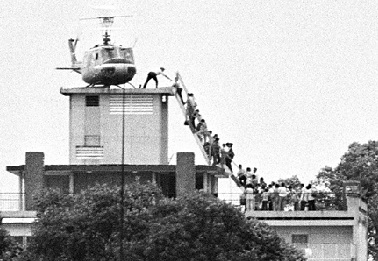
Capturing a moment of desperate retreat-these are CIA
 and American embassy personal fleeing Vietnam.
Photo: https://en.wikipedia.org/wiki/Fall_of_Saigon  

When American radio announced that the temperature was "a hundred and five degrees and rising" followed by playing Bing Crosby's "White Christmas," few knew it had any significance. Exact numbers of how many who did are uncertain, but those who knew gathered their belongings-it was an evacuation signal. At this point in Saigon, (April 1975) it was time for the Americans and their South Vietnamese allies to flee. The enemy was at the gate, literally, the communists were just outside the city. Waiting until the last moment to flee South Vietnam, the American embassy personnel had by default whittled their options down to one, mass evacuation by helicopter. The photo above was taken during that time as helicopters flew back and forth countless times from ships in the South China Sea to Saigon ferrying loads of desperate people.


Salt Lake City summers are hot. "C'mon, you live in a desert" you say. I know that, and I like that, it doesn't make the summer months easier though. So just like the democracy loving people that knew their time was up once they heard it was "a hundred and five and rising," I knew when I needed to run from the heat further into the mountains.


Dillan telling me to Cool Your Jets.

These few routes are near Pentapitch and right next to the river. That
means they are some of the coolest in the canyon....

...it probably helps that it is north facing as well.
They have fun movement on them as well!

Wednesday, June 1, 2016

Selective reabsorption.

Flowers in the Swell


The physiology of human kidneys are outrageously interesting. Obviously there exists complexities, but in general, simplicity seems to be the byword. This idea commands the kidneys and as a whole, human physiology, which is actually one of the most creative and simplistic things I've ever seen. Small changes affect the entire functional unit (the nephron in the case of the kidneys) which affect the entire body.


A nephron, this wacky looking thing is the fundamental functional unit of the kidneys. You actually have about a million of each of these per kidney! It looks like something I'd draw as a child.
photo from: http://www.highlands.edu

So how does the kidney filter what stays in your body and what needs to leave? Some portions of the nephron (like the proximal convoluted tubule) are pretty independent and reabsorb the same stuff in the same quantities all the time. Others do what is called selective reabsorption. Depending on variables such as hormone concentration, ion concentration in the blood, blood volume, blood pressure, and osmolarity (big word!), the kidneys can take the hint and adjust what they reabsorb back into the blood to maintain homeostasis!

For example, say you have not drunk enough water and you are becoming dehydrated. Your kidneys have cells that can sense this, and through changes in hormones which result in actual structural changes, the nephron become more porous and can reabsorb more water so you urinate less and retain more water inside your body. The reverse is also possible if you over hydrated.

We all selectively filter what happens and what we take part of in our lives. I was able to filter an extra day of climbing in and visit a canyon in the Swell I had never visited, and I can't wait to filter some more back in!


My first visit to Three Finger Canyon


The West Slabs of the desert (we called it), we cruised up the two long
easy classics of the area......


.....and then continued running along the ridge forever. Why not?


I often find that climbing in the desert is about spotting the coolest features and climbing them.
The rock is crumbly, the gear falls out, but the lines are classic. This is a nice example.