Wednesday, June 1, 2016

Selective reabsorption.

Flowers in the Swell


The physiology of human kidneys are outrageously interesting. Obviously there exists complexities, but in general, simplicity seems to be the byword. This idea commands the kidneys and as a whole, human physiology, which is actually one of the most creative and simplistic things I've ever seen. Small changes affect the entire functional unit (the nephron in the case of the kidneys) which affect the entire body.


A nephron, this wacky looking thing is the fundamental functional unit of the kidneys. You actually have about a million of each of these per kidney! It looks like something I'd draw as a child.
photo from: http://www.highlands.edu

So how does the kidney filter what stays in your body and what needs to leave? Some portions of the nephron (like the proximal convoluted tubule) are pretty independent and reabsorb the same stuff in the same quantities all the time. Others do what is called selective reabsorption. Depending on variables such as hormone concentration, ion concentration in the blood, blood volume, blood pressure, and osmolarity (big word!), the kidneys can take the hint and adjust what they reabsorb back into the blood to maintain homeostasis!

For example, say you have not drunk enough water and you are becoming dehydrated. Your kidneys have cells that can sense this, and through changes in hormones which result in actual structural changes, the nephron become more porous and can reabsorb more water so you urinate less and retain more water inside your body. The reverse is also possible if you over hydrated.

We all selectively filter what happens and what we take part of in our lives. I was able to filter an extra day of climbing in and visit a canyon in the Swell I had never visited, and I can't wait to filter some more back in!


My first visit to Three Finger Canyon


The West Slabs of the desert (we called it), we cruised up the two long
easy classics of the area......


.....and then continued running along the ridge forever. Why not?


I often find that climbing in the desert is about spotting the coolest features and climbing them.
The rock is crumbly, the gear falls out, but the lines are classic. This is a nice example.


Sunday, May 15, 2016

Types of failure.


A view of the south side of Rock Canyon from the run up Squawstruck on Squaw Peak
and a lifetime of untouched stone...if you have to desire to work.

It has been said that there are really only three reasons for failure on a climb. Not strong enough, not good enough, or not brave enough.1  

The last few months have been a rush. My spring semester absolutely flew to the end from overwhelming amounts of tests and projects, and compounding those time consuming activities, the rain, snow, and freezing temperatures in the valley lasting all the way to May had (to my embarrassment) kept my climbing "socked in". I am usually more than excited to climb anything, regardless of how big it is or what the weather is like. But, like I was complaining to the delight of my friends who primarily ski, it has been a skiing spring and not a climbing spring. Weather too warm for ice but cold enough for snow, and precipitation constant enough to keep the powder fresh and but the rock soaking wet were the culprits. And because of my studies my abilities to climb where limited, even considering "rallies" to outside ranges. While I could have found time to boulder, I really just didn't feel like it, I was itching to get into the mountains (probably because this time last year I was in Alaska). So I tried, failed, and have examples of each reason failure exists. While failure can result from any combination of the three core reasons, each example listed fits into one category well enough to classify it as such.


Not strong enough.


As of this post, my friends Paul and Jackson hold the highly coveted (not, I'm absolutely sarcastic) speed record for the local Squawstruck; 3 hours and 43 minutes car-to-car. I have climbed the route before and when Korey wanted to climb it for the first time, I suggested we simul climb it and see how we stacked up. We pulled out a time of about 5 hours total, even with pitching out the upper buttress from fatiguing forearms. Talking with Paul, we concluded it would be easy to drop the official time by a huge margin, both of our teams were never rushing the climbing and a large portion of our time came from the 1.5-2 hours of hiking. In reality this record will be the domain of runners who can climb 5.11.


In the middle portion of the route Korey kept
the moderate pace on the moderate terrain.


Korey in my least favorite portion of the route. Paul and I laughed about
how the pitch Korey is on is Paul's favorite and my least favorite on the route.


Not good enough.


Wanting to develop my ability to both climb on granite and climb trad, I decided to start working on Prowser, a beautiful prow up Little Cottonwood Canyon. Still, even though I have not sent it, it has been a pleasure to learn this route and spend time here.


Still top roping...


Those darn rain clouds never left this spring.


It's quite blank to either side of the prow.


Not brave enough.


Last year when I visited Wheeler Peak for the North East Couloir (The Wheel Deal), we were in t-shirts by mid morning in April, it was hot. Basing my assumptions on last year, I thought that since it was a whole month later, attempting a rock climb in the same basin would be perfect this time of year. Christian and I each brought fleece gloves, a thin fleece jacket and a hat. When we walked into the cirque onto the glacier, we were freezing and the temperature was below zero. We couldn't stay warm even running around and were both scared of the walk off down couloirs with ice hard snow sans crampons, so we high tailed it out.


Oh there should be a little snow... Christian glad
to not be on a temporary snow bridge.

In the beautiful cirque with the buttress we wanted
 to climb in the center of the photo.

While I definitely don't support the carving
of trees, I have seen worse.


1 Check out Training for the New Alpinism by House and Johnston.

Monday, February 29, 2016

Climbing with chirality.


Booting up towards the ice. Spacial awareness is important here, as well as with chirality.


****WARNING: science alert. Skip down if you aren't interested, the photos are good.*****


In organic chemistry, one of the hardest concepts to understand includes something called chirality. Now hold on, before you go look at cat videos, lets give this concept a shot. This is hard to explain in words, but is usually visualized better by look at photos. Make sure to check out the ones below. However, more or less, the concept is basically that you can have different kinds of the same molecule depending on how all of the atoms are bonded in relation to each other. A subpart of this idea is something called enantiomers (a big word, stick with me here). Enantiomers are mirror image molecules that are not superimposable; a good example of this is your hands. They are mirror images, but you cannot slide one on top of each other and make it match, your thumbs stick out on either side. Got it?
Don't get worried about the names, the idea is to see how they are mirror images. The blue atom in front and on the right
is now the blue atom in front and on the left. they all have switched positions relative to each other.
Photo: worldofbiochemistry.blogspot.com 
                             

It is hard to see how it all applies. With this photo, you can see how those specific
spacial arrangements matter for the binding sites that are so specific.
photo: http://www.kshitij-iitjee.com/


Now that we have an idea of enantiomers, we can look at biological molecules. Chirality is important in biochemistry since molecules form 3D structures in space and each enantiomer has a unique shape, even while being the same chemical. Weird right? This becomes important because each protein in your body has a specific spot that it will bind with other molecules, and it has a unique shape. So often times, only one enantiomer will work, while the other just will not fit; just like a lock and key.
Advil or ibuprofen is a cool chemical. The ibuprofen you buy comes in a 50/50 mixture of both enantiomers (mirror image molecules), and only one of the them is biologically active. What you say, I purchased the whole bottle and only half of it works!? No, what is interesting about ibuprofen, is that your body will change the inactive version into the other active version when it starts running out. Pretty rad. Cocaine on the other hand is different. When synthesized by humans (natural pure cocaine is the 100% biologically active enantiomer) it comes in a 50/50 mix just like ibuprofen.  What is interesting about cocaine however, is that your body cannot change the inactive enantiomer to another. So you do only get half the active amount.
Why is this relevant? Well, I feel like climbing is more like ibuprofen than cocaine. Climbing is such an undefined sport with countless facets, that whatever you are psyched on, we can find something for you. We can always change our "climbing enantiomer" to another we need or want.  When the ice is good, go ice climbing! When it is not (in Utah the weather likes to keep you on your toes) just go rock climbing! Different styles, different areas, different people, it is never old, if you don't want it to be.

Ice Climbing

The Donercicle in WI6 mode. One of my favorite pillars.
                               

Matt is strong, I am pretty sure it is because his tools and crampon colors match....


You have to love CCC falls. I only wish there was a way to
have a mixed route to the right without drilling.


Rock Climbing


The worst part of having so much gear, is deciding if we should take it?

If only there was more ice on the river, we could have walked
there instead of bushwhacking.


What a beautiful place. Even with the La Sals obscured by
clouds in the background, there is an immensity to the area.


Monday, January 11, 2016

We'll do more, we'll deserve success.


A image from the first edition of Joseph Addison's play Cato.
oll.libertyfund.org 
"It's not in mortals to command success, but we'll do more, Sempronius, we'll deserve it."1


George Washington was influenced by the play Cato. So much, that he even had it performed for his soldiers. He quoted the above line often and even personified it.

"If [the British generals] and others of like mind thought the war was over and that the British had won, Washington did not. Washington refused to see it that way.... Out of adversity he seemed to draw greater energy and determination. 'His Excellency George Washington,' wrote [General] Greene later, 'never appeared to so much advantage as in the hour of distress.'"2

In climbing a key to the successes I have had, has been this. You have to put in the work and be in the right place to deserve the success since we cannot command success ourselves.


Big Cottonwood Canyon


On Hidden Falls in Big Cottonwood Canyon, I was wandering up above the route after climbing it looking for more and stumbled upon some ice. If you walk up the gully and take a left when it forks, you can hike up hill and find this. It is absolutely hidden by a rock bulge and its aspect until you are right at the base of it. Pretty mellow, but cool to make the route just a little longer. This is Hidden Falls, and as author of Beehive Ice, Nathan Smith says "people have been tromping around there forever". So a FA? I don't know, but it's worth doing!

Upper Pitch of Hidden Falls
WI3 M2
Sawyer Wylie and Ezra Wylie


Sunbaked and manky, but who cares? I just
didn't catch it on the right day.


It was actually a pretty steep little section.


Followed by more of the same fun!


American Fork

This was a line I had kept an eye on for a while, often falling down and reforming with the fluctuating conditions. When it formed enough for me to try, I made it a priority. I called Jackson, actually a climber I had never roped up with, and we decided to try for it enough that we deserved success on it. And we did! Who knows if this is a FA as well, but either way, I hope someone else goes and does it.

Faction Friction
WI3 M4
Sawyer Wylie and Jackson Marvell

A three bolt mixed line bolted on lead up the left side and then a transfer to the ice. The curtain could form enough to be a pure ice line I believe, but not when we were there, it was just a dagger. There could be a short 3 to 4 bolt M7 or so behind it leading to the dagger then up the ice that looks cool.


Nice, fat, and growing, I didn't mind grabbing it!


Here is a photo of it all covered in snow helping
 it form the day before we climbed it.


You can really see the position of the line relative to other
 main lines in the canyon like Habeas Corpus and White Lie.


We started the route a little lower than that curtain in the upper photos.
The curtain is actually on step two in this photo. Starting this low though, turned
it into a full 70 meter pitch! Photo by Jackson Marvell


1 From the Play Cato.

2 Information and a quote from one of my favorite books 1776 by David McCullough.

Saturday, December 5, 2015

Subjectivity in objectivity.


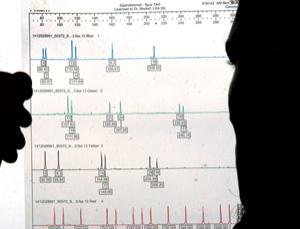
The peaks of a "map" of DNA.
Found at www.newscientist.com

DNA testing and evidence and is often portrayed and thought of as THE standard to be compared too. A sort of holy grail for forensic science, it is commonly idealized as the ace in the hole piece of evidence. Those unfamiliar with it more often than not are convinced that DNA evidence is irrefutable. Wait, isn't it?

Unfortunately, it depends on your perspective. How could that be? Either your DNA matches or it doesn't, it's science. A typical DNA "reading" so to speak, consists of peaks related to repeated pieces of DNA found in specific areas called loci. Problems come in when you have DNA that is not ideal (either partial, mixed, contaminated, or old samples) as well as subjective bias from lab technicians as to which loci should be compared.

Subjective bias? Strangely enough, there are very few standards followed by labs for criminal DNA testing leaving interpretation of the results to the perspective of the technician, and the fate of the accused even varying by lab!1

As an ice climber in Utah, I learned long ago that personal bias and abilities, expectations, pride, and subjective interpretation comes into play when talking about conditions, just like DNA analysis. Even though I love it, climbing ice here is fickle. So you try to wildly hypothesize what is in, what is climbable, and at the same time, hunt for any knowledge already out there.

I was told "man, it's too warm, you might be able to get on the staples in Provo Canyon, but that's about it." In fact, I went out onto the Great White Icicle afternoon the other day and I didn't even bother going past pitch 3. Why push it through poor ice when we still have months too go?

Still, there is climbing to be had, and we decided we would rally up to "Hell Froze Over" WI5 M5 X on Hellgate in Little Cottonwood Canyon.


My calf's are getting pumped!


How can you not love mixed climbing?


Just think, if this pitch takes more than 30 minutes, it will
count as an ARC session! We must follow the Rock Prodigy training
gospel of the Anderson Brothers!


Never let climbing get in the way of a good training session for
climbing Shad counsels during the final runout.


Back down in time for lunch! A demonstration of the perfect rope toss.
All Photo by Sawyer Wylie


1 Pretty wild huh? Should you be interesting in reading more on the subject, please follow the links below: https://www.newscientist.com/article/mg20727733.500-fallible-dna-evidence-can-mean-prison-or-freedom/ http://stories.frontline.org/dna http://www.scienceandjusticejournal.com/article/S1355-0306(11)00096-7/abstract http://www.post-gazette.com/local/city/2015/10/10/Court-to-decide-defense-request-for-secret-DNA-computer-source-code/stories/201510100063

Monday, November 30, 2015

The billion dollar lesson.

The magical Sundial casting its long shadow.


During the 1980's the city of Moscow was a forbidding enviroment. Sure it was physically cold, but more importantly, "Stalin was convinced the World Was II victory over the Nazis demonstrated the unshakability of the Soviet state" and he "deepened the brutal, closed system he had perfected...creating the perpetual struggle against 'enemies of the people' and 'spies'." The CIA during the time was still new to the game of espionage; and with the unforgiving environment that was the capital of the USSR and the brutal KGB roaming the streets carrying out the Stalin purges, intelligence was quite literally nonexistent.

How was it then that during this time the most effective spy in American history, "The Billion Dollar Spy", came to pass? The praise goes primarily to the actual spy, Adolf Tolkachev, but a portion I believe is due to the CIA. Through persistence during their years of attempts of recruitments and operations in Moscow, they picked up on little nuances about the city. One thing they realized was that "KGB surveillance teams almost always followed a car from behind. They rarely pulled alongside. It was possible for a car carrying a CIA officer to slip around a corner or two, momentarily out of view of the KGB. In that brief interval, the CIA case officer could jump out of the car and disappear. At the same time, the Jack-in-the-Box would spring erect, a pop-up that looked, in outline, like the head and torso of the case officer who had just jumped out."1

The Jack-in-the-Box.
credit: http://www.gizmodo.com.au


Using these skills learned from their tenure in Moscow, including the Jack-in-the-Box, officers were able to dodge their KGB tails, meet with spies, and retrieve information. Since 2009, I have spent my winters climbing in the Wasatch racking up days getting skunked, climbing ice, and generally just learning about my favorite mountains. Keeping an eye on the weather, and comparing it with past year's temperatures, and precipitation Early this month I decided that the Sundial ice, Frozen in Time, should be ready earlier that expected.
Matt and I made the approach with snow still low on the ground and managed to have a great time getting the seasonal first ascent on November 10th. Now that really isn't much to get excited about, but the idea of being first for the year makes things fun and when you are having to hunt for ice that acts like a real Jack-in-the-Box, it amplifies the fun. It is things like this that contribute to climbing being continually interesting (I think) and I only realized there was a chance that it was ready to climb from the experiences I have from my tenure as a climber here.


Starting up it is really hard to believe
that it is a full pitch length.


I always feel I need a good warm up
and refresher to moving on the ice again.


Heading home, all the while laughing at the idea
of breaking trail in waste deep powder to get here.


The mountain with the ice to it's right.
All photos: Matt Berry.


1 All quotes came from The Billon Dollar Spy by David E. Hoffman

Sunday, October 18, 2015

Can anything good come out of there?


Out on an unknown problem somewhere between Triassic
and Joes Valley. Is there anything good out there?
Photo by Ian Crookston


45. Philip findeth Nathanael, and saith unto him, We have found him, of whom aMoses in the law, and the prophets, did bwrite, Jesus of Nazareth, the son of Joseph.
46. And Nathanael said unto him, Can there any good thing come out of Nazareth? Philip saith unto him, Come and see.

John 1:45-46


The above passage from the Bible is an interesting one. In that current age, the city of Nazareth was certainly not anything special. We can see that Nathanael was incredulous because in addition to the idea of the Savior of the world being raised in such a common place, is that the prevalent view in his day was the idea "that the Christ was to come in a royal state as seemed befitting the Son of David."1
Philip's answer is admirably simple "come and see."

Something I find beautiful about climbing is the many places to see, experience, and learn from. There is no specific arena you must play in to be a real climber, no designated hitter to call in for you, and always a tomorrow to prepare for and try again. To my perspective, that is part of the soul of climbing. There are always places to explore, new routes to climb, and all boulder problems and routes possess some part of the machine that is climbing. We can then assume that you are capable to appreciate climbing wherever you climb, your local crag or the largest meccas. Am I trying to say that your local crags are as good as the meccas? Well that depends on what values we compare, what I am comparing are many of what I consider core values of climbing (self improvement, friendship, enjoyment, exercise, an excuse to outside, adventure, education). When I do so, I realize they can be achieved wherever you are climbing.


Nazareth aka LCC


In one of my local Nazareths (Little Cottonwood Canyon) exist beautiful slabs of granite made to climb on.


A view from on high of Little Cottonwood.


Jordan reaching for his first piece from an oasis
 that is a classic LCC xenolith.


Whew, no factor 2 falls off friction slab onto
 the belay today. Now where to go?


A view of the thumb, one of the most prominent
landmarks in the canyon, from the Gate Buttress.
Can you really complain?


Rome aka Yosemite


As far as my understanding goes, the big city in Jesus's day was Rome. Starting from the history of climbing, Yosemite is still a likeness of the mecca it once was. Little Cottonwood has smeary feet, flared cracks, and finicky pro. Yosemite on the other hand, has better versions of all three (typically).


With better version of all three, no wonder
it is a Mecca!
Photo: Zeppelin Zeerip


Sorting gear while waiting in line on
The Central Pillar of Frenzy, Middle Cathedral.
Photo: Zeppelin Zeerip


The Captain across the
valleyfrom the same line.
Photo: Zeppelin Zeerip 


Everyone afloat on the
vertical ocean of granite.
Photo: Zeppelin Zeerip


1 Jesus the Christ by James E. Talmage